About Me
I am a quant researcher focused on execution at both the high (parent) and low (order routing) level. I also dabble in market-making and alpha signals when there is a spare 5 minutes at work.
Previously, I was a quant at BestX and spent the day researching financial markets with a focus on transaction cost analysis (TCA). Hopefully I shared some interesting insights about the world of FX, fixed income and equity trading and built some cool product features.
I have a PhD in Statistical Science from University College London (UCL) and my thesis was Bayesian Nonparametric Hawkes Processes with Applications. I also have an MRes in Computer Science and an MPhys in Theoretical Physics from the University of Manchester.
I run a dashboard for crypto liquidity and pre-trade analytics: https://cryptoliquiditymetrics.com/
I’m an open source contributor with multiple projects ongoing: dirichletprocess, HawkesProcesses.jl, AlphaVantage.jl, CoinbsePro.jl, AlpacaMarkets.jl.
I’ve written guest posts for QuestDB:
- High frequency finance with Julia and QuestDB
- A tour of high-frequency finance via the Julia language and QuestDB
Want me to write for you or have something else interesting? Email me at dean[dot]markwick[at]talk21[dot]com
Talks
- Execution algorithms and adaptive strategies, FX Markets Europe 2025
- Disruption or Optimisation? AI’s Role in the Future of Trading, Fixed Income Leaders Summit 2025
- From Capitol Hill to the FX desk: How US policy impacts FX execution, TradeTechFX 2025, Europe + USA
- Mo Dealers, Mo Problems, QuantMinds 2023
- Unique Liquidity and Measuring Execution Quality, TradeTechFX 2023
- Machine Learning Property Loans for Fun and Profit
- Simulating RFQ Trading in Julia
- Using Hawkes Processes in Julia: Finance and More!
- Optimising Fantasy Football with JuMP
- Building the BestX Event Risk Model using HawkesProcesses.jl
- State of the Market
Articles
- FX Execution Costs and US Policy: What Does Liberation Day Tell Us?
- What Happens When a Primary FX Venue Goes Offline? - 3rd most read article of 2023 on Full FX.
- FX Markets Remained Orderly During Recent Interventions
- To Cross or Not to Cross
- Choppy markets revive quest for RFQs magic number
- Volatile FX markets reveal pitfalls of RFQ
- Price limits in FX algos: fill your boots
- BestX RFQ Par Introduces a New Way to Look at Hit Ratios
- How Long Should TWAP algos run?
Some are behind a paywall.
Outside the Day Job
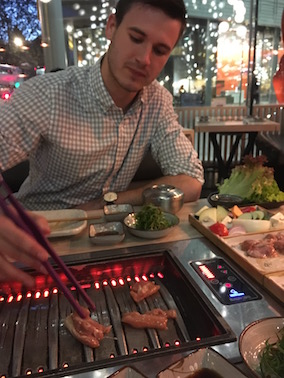
I also have a keen interest in sports modelling and how statistics can be used in professional sports and gambling, I enjoy a good film, watching a boxset too quickly and a bit of a foodie. Here I am enjoying some delicious Korean BBQ.
My blog is also aggregated on https://www.r-bloggers.com/ and https://www.juliabloggers.com/.
Recent Post:
-
Big Ticks and Small Ticks in Equity Microstructure
I bought Trades, Quotes and Prices a few years ago and it came with access to some free data to help you understand the concepts. That data was from LOBSTER and it has the limit order book (LOB) of five tech stocks for a single day in 2012. I did a quick top of book size calculation in Python and the liquidity profiles looked completely different. Intel and Microsoft had hundreds of thousands of dollars at the best prices, while Google and Amazon had only a fraction of that size. So my first thought was that the orderbook data needs some explaining and basic analysis before going into anything more complicated. In this post, we’ll cover how to load and parse LOBSTER data in Python, calculate core microstructure statistics, and explore how a stock’s tick size changes how it trades (big-tick vs. small-tick stocks).